POWER
About a tenth of a watt
UKHSA says Wi-Fi signals are very low power, typically 0.1 watt, in both the device and the router, at frequencies broadly the same as FM radio and mobile phones.
See the numbers
WHAT THE HEALTH ADVICE SAYS
CALM the facts
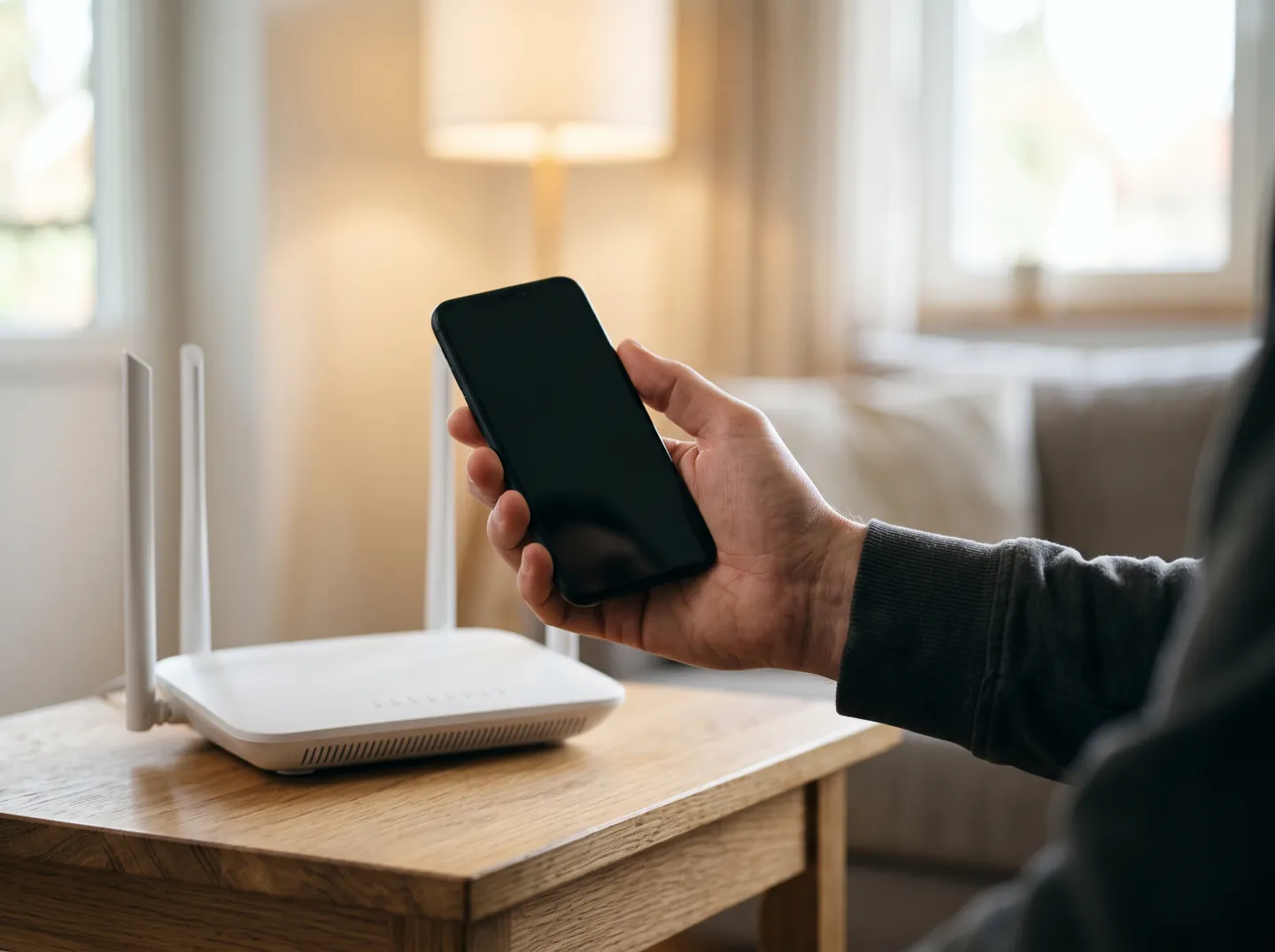
AI-generated image, not a photograph of a real person or place.
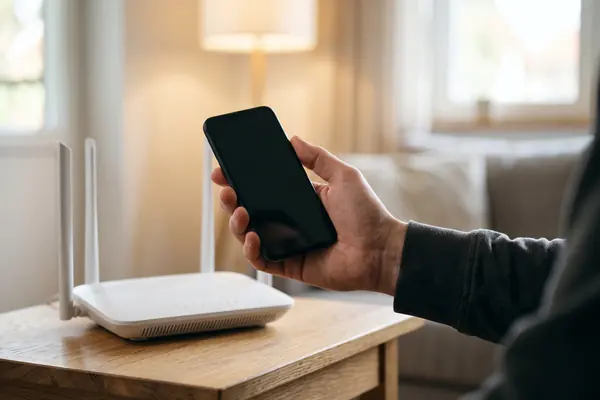
Your router and devices talk to each other with radio waves.
Some of that energy is absorbed by people nearby, which is why health agencies have measured it. The UK Health Security Agency's view is that Wi-Fi exposure is small compared with international guidelines.
THE SHORT ANSWER
UKHSA sees no reason to stop using Wi-Fi.
It says no extra action is needed to cut exposure.
POWER
UKHSA says Wi-Fi signals are very low power, typically 0.1 watt, in both the device and the router, at frequencies broadly the same as FM radio and mobile phones.
See the numbersTIME
In lessons at 6 schools, the 146 laptops studied were sending radio signals only 0.08% of the time on average. Access points averaged 4.79%.
Check each deviceDISTANCE
UKHSA says Wi-Fi exposure is likely to be lower than from a mobile phone held for a voice call, because Wi-Fi antennas tend to be further from the body.
What it meansGeneral information only, not medical advice. For advice about your own health, speak to a doctor, pharmacist or other qualified health professional.
FOUR THINGS TO KNOW
UKHSA says no additional action is necessary, communally or individually, to reduce Wi-Fi exposure further. These points explain why.
Wi-Fi uses bands near 2.4, 5 and 6 GHz, broadly the same frequencies as FM radio and mobile phones.
WHO and ICNIRP both say heating is the main effect of radio waves. Everyday levels are very much lower than those needed for significant heating.
Wi-Fi antennas usually sit further from the body than a phone held to your ear, which is one reason exposure tends to be lower.
WHO says evidence does not support a link between low-level fields and symptoms such as headaches or fatigue, and some may come from noise or other factors.
TWO NUMBERS WORTH KNOWING
One figure from UKHSA's guidance,
one from its measurements in schools.
0.1 watt
Typical output power of a router or device
That is 100 milliwatts, in both the user device and the router. UKHSA's measurement programme found Wi-Fi exposures small in relation to the ICNIRP guidelines.
WI-FI AND HEALTH · UKHSA
0.08%
Average share of time spent transmitting
Applying measured duty factors, the maximum time-averaged power density from a laptop was 220 microwatts per square metre at 0.5 metres.
146 LAPTOPS · KHALID ET AL. 2011
ICNIRP says the only substantiated health effect of radio-frequency fields is heating of tissue, and its limits are set below the threshold where that becomes harmful, with extra conservative margins.
A QUICK DEVICE CHECK
Wi-Fi sends data in short bursts, and guidelines allow exposure to be averaged over time. Pick a device to see the share of time it was transmitting during real school lessons.
Measured with radio packet capture in 6 UK primary and secondary schools. Homes will differ with how the network is used.

WHY THE SURFACE MATTERS
Radio waves can pass into the body, and the higher the frequency, the less deeply they go. UKHSA notes that at higher frequencies the absorbed energy, and any heating, becomes more confined to the body surface.
ICNIRP limits cover all frequencies up to 300 GHz, well beyond Wi-Fi's 6 GHz. They are set in relation to the levels known to cause harm, with conservative margins added for scientific uncertainty, and measured public exposures remain well within them.
In conversation
UKHSA says there is no consistent evidence that exposure to radio signals from Wi-Fi devices adversely affects the health of the general population, and sees no reason why Wi-Fi should not continue to be used.
UKHSA gives a typical figure of 0.1 watt (100 milliwatts) for both the router and the user device.
The Health Protection Agency, now UKHSA, measured networks in schools and found exposures small in relation to ICNIRP guidelines. UKHSA sees no reason not to use Wi-Fi in education.
UKHSA's study found Wi-Fi devices generally have lower time-averaged output power than mobile phones, and exposure is likely to be lower than a phone used for a voice call.
WHO says there is little scientific evidence to support it: people did not show consistent reactions under properly controlled conditions, and there is no accepted biological mechanism.
Each figure on this page comes from the sources below.
ABOUT THIS NAME
wifisurface.com is part of the DoodleSale portfolio. It isn't in an auction right now, but you can ask about leasing it.